


Think of the humble ATM. It is a mundane part of any cityscape: covered in graffiti and stickers outside of 24-hour convenience stores, or sitting behind the glass at the entrance to your local bank branch. You’ll often find them in airports, gas stations, and restaurants. It’s hard to imagine we once saw these machines as a disruptive technology.
But that’s just what they were: an automated bank teller. ATMs automated a role that had been performed by humans, akin to some of the new AI tools launching and expanding today. However, the ATM was evidently not the end of the bank teller profession. In fact, the number of human bank tellers grew after the advent of the ATM in the 1960s. By enabling bank branches to operate successfully with fewer tellers, ATMs made it more cost-effective for banks to open more brick-and-mortar locations. Between 1970 and 2010, the number of bank tellers working in the U.S. doubled.
However, since 2010, the number of bank tellers has fallen to around 250,000 due to the widespread adoption of online banking technologies. But the loss of roles does not correlate to a drop in total bank employees—that number has stayed roughly the same, with these workers taking on different tasks, such as managing and selling investment and insurance products, which contributes to banks’ long-term profitability and leads to more fulfilling jobs.
As AI further advances digital banking, we wonder what will happen to jobs in this sector. It’s true that there are likely to be shifts and adjustments. But are we really in unprecedented territory? Or has new technology always replaced certain jobs while creating new ones in their place?
This cycle is captured by the term creative destruction. This term has a lengthy history itself: it was coined by economist Werner Sombart in 1913 and later became a crucial aspect of economist Joseph Schumpeter’s 1942 book, Capitalism, Socialism, and Democracy. In that time alone, the term had withstood the major societal upheaval of two World Wars. It has continued to be true through space exploration, the technological revolutions of the past fifty years, and demographic shifts to the workforce. Sure, our world is tumultuous now—but creation and destruction have always been necessary aspects of advancement.
This is not to say displacement never happens or that we shouldn’t worry about it in the short-term. The automation of certain tasks is the first step in this process. Some jobs will be lost. But it may not be the apocalypse we’re envisioning now. Many of the speakers who decry AI’s cataclysmic impact are also those tasked with selling or producing the technology: Elon Musk, Sam Altman, and more. These people may have insider knowledge, but don’t they also have competing interests and capitalistic incentives? Whether positive or negative, public belief in AI’s impending world transformation posits the technology as powerful and successful.
But there are many tasks that remain yet to be mastered by AI. These tools will require human oversight and be shaped by human interaction. This is not unique to AI. As they develop, new technologies drive new industries and ventures, creating space for—you guessed it—new jobs.
In early 2026, the National Bureau of Economic Research published the below chart, which illustrates the shares of new patents related to specific task types—manual, cognitive, and interpersonal—from 1850 to 2010. Major technological shifts, including the Industrial Revolution, are encapsulated by this time span.
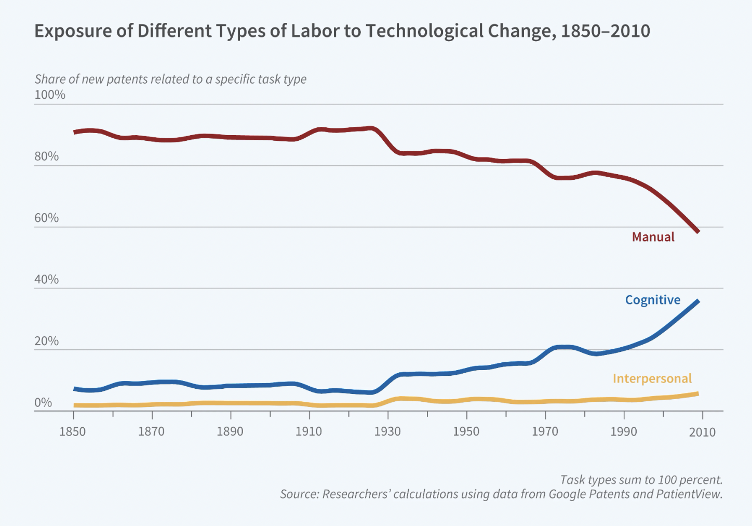
As expected, most patents back in the 19th century were for manual tasks, and this has steadily fallen since, with an especially sharp dropoff going into the 1990s. Meanwhile, the shares of cognition-related patents have risen, especially since 1990.
Just because the number of manual labor-related patents has fallen doesn’t necessarily mean there are less new patents overall. Rather, what has changed is the prevalent type of labor. Most of the population used to be agricultural workers. That’s not the case anymore. But that doesn’t mean those of us who would’ve been farmers 200 years ago are now out of work entirely—we’re just doing something different.
But let’s look at a more contemporary example: the Digital Revolution of the late 20th century. Microsoft and Apple, personal computers, the World Wide Web. The five largest companies in the world today are Microsoft, Apple, Nvidia, Alphabet (Google), and Amazon—none of which existed fifty years ago. These technologies created new industries and new companies, along with a massive number of new jobs, that all radically shifted the way humans perform work. There are tons of employees whose roles wouldn’t have predated these technologies: IT experts, digital marketing teams, and software engineers.
But is this time different? Technology does seem to be moving faster than ever before, as does customer adoption.
When technological shifts happened at a slower pace, workforces could adapt more naturally. With AI technology, and especially due to the fervor with which certain sectors are embracing it, employees have had to adjust in just a few short years. Even relatively recent college graduates are now working in a world that their universities could not have directly trained them for.
What becomes valuable, then, are the transferable skills: problem-solving, team-building, empathy, conflict resolution, and creativity. From the company perspective, learning how to leverage AI to enhance your employees’ roles as well as the value of your products and services is imperative. Learn how to interact with the technology-enabled stakeholders around you. While moments of discomfort may occur during the process, they are natural parts of the creative destruction cycle.